/
·

Co-Founders, Sparkonomy
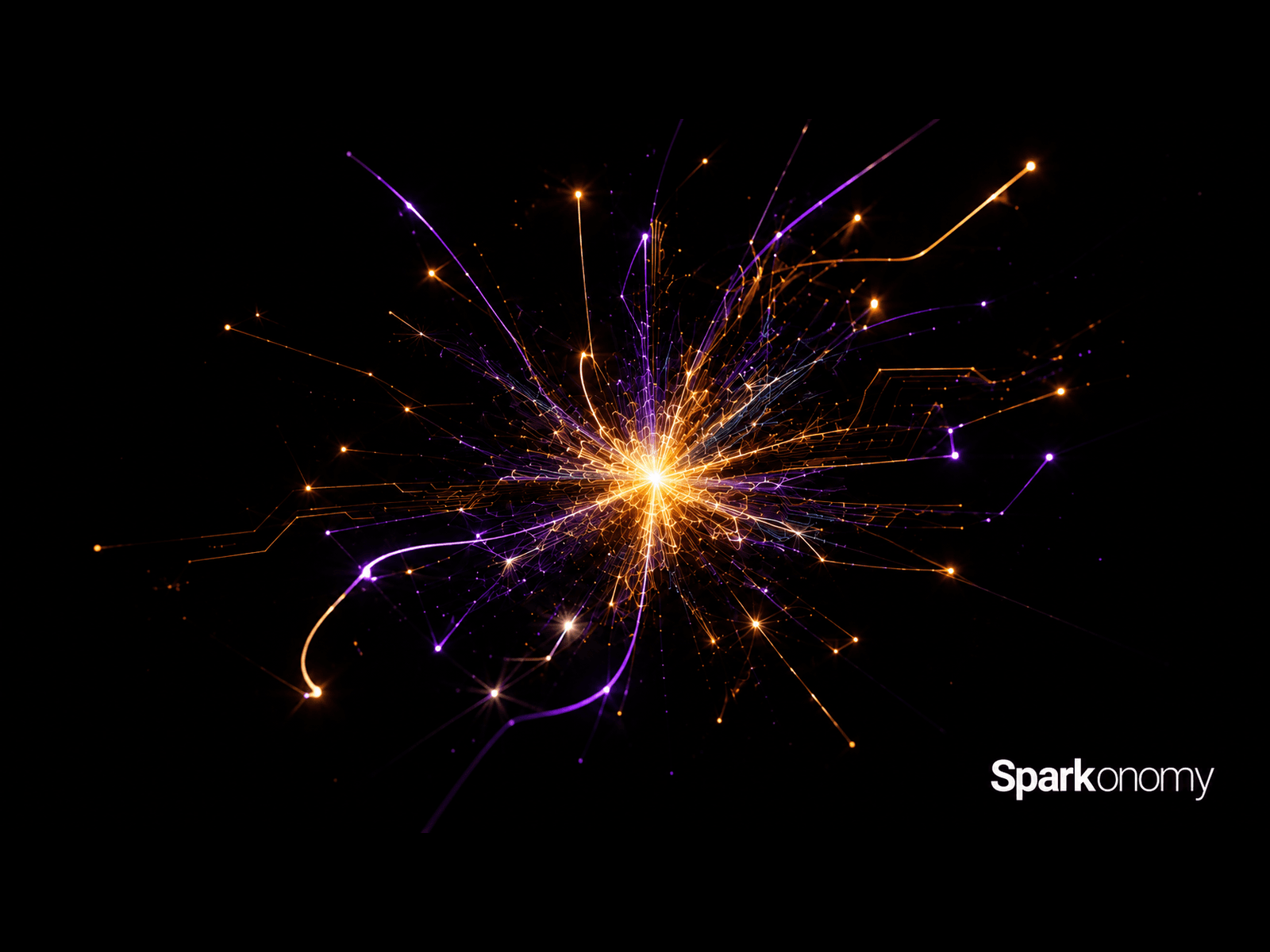
When we incorporated Sparkonomy in early 2025, “Spark” was the first word we wrote down. Before the product roadmap, before the pitch deck, before the first line of code — there was a word we kept returning to. It felt right. So we sat with it, pulled it apart. And the more we examined it, the more it held.
Then came Google I/O 2026. Google announced Gemini Spark — their new personal AI agent. Within hours, messages started coming in. Did you see this? Some were curious. Some were amused. A few thought we should be worried. We thought the exact opposite. The most resourced technology company in human history had just spent its biggest annual stage on the same word we built a company around. That wasn’t competition. That was confirmation.
So here is what the word actually means. And why we think it’s the only one that gets the AI moment right.
The name you give your AI agent — Gemini Spark, Claude, Manus — isn’t a branding exercise. It’s a worldview.
Operator tells you AI is a process, a function routed through a system. Devin and Claude tell you it is a colleague, something you work alongside. Atlas tells you it bears weight. Hermes carries messages. Manus tells you it is a direct extension of human action.
Each name tells you something.
Then there is Spark.
Spark is not a role, a person, a myth, or a gesture. Spark is an event. A moment of ignition between two things that could not produce it alone. And that is what AI actually is when it works the way it should.
The word is older than any of those frameworks. Much older.
In Old English it was spearca. Proto-Germanic Sparkō. Across Dutch, Old Norse, early German — always the same image: a flying particle of fire, brief and purposeful, born in a collision.
Sanskrit gives us sphuling — स्फुलिंग — from the root sphul: to flash, to burst forth. Not a sustained flame — and yet the Vedic tradition understood something a dictionary definition misses: the flash and the eternal are not opposites. Agni — the Vedic sacred fire — is energy that is both material and metaphysical, already alive inside all things. The Spark is not something you find. It is something you release.
The Greeks understood fire differently. Prometheus crossed worlds to steal it — fire was not within, it was out there, to be pursued, carried, fought for. And from the sacred flame at Olympia, one fire lit thousands of torches carried across mountains and seas, gathering a civilization around its warmth.
East and West arrived at this word from opposite directions. One felt the Spark within. The other reached outward for it. And yet both arrived at the same truth: the Spark is where everything begins. Pervasive — in matter, in reason, in the act of creating.
But the Spark was never the mystery.
Not where a Spark comes from. Where it goes. What separates the Spark that dies in an instant from the one that becomes a flame warm enough to last — and light everyone around it.
That question is now alive, in the Creator economy.
Every Creator carries a Spark — uniquely theirs. Nobody else’s. A voice, a story, a perspective — a burst of creative energy sent into the world to find its audience. But Sparks are fragile. Without the right conditions, without the oxygen of tools and infrastructure, they extinguish — not because they weren’t real, but because they never got the chance to become the flame they were meant to be.
Sparkonomy is built for that moment. The moment between the Spark and the flame — where AI agents become oxygen.
These Sparks have names. And kitchens. And cameras. And two hundred unanswered job applications.
There is a woman in Agra, India who learned to cook from her mother, the way her mother learned from hers. No culinary school. No marketing budget. No industry contact. She started filming in her kitchen with a phone bought on installments. She now feeds an audience of millions.
There is a young woman in Riyadh who started creating fashion and lifestyle content as her country rewrote the rules of what women’s voices could sound like in public. She did not wait for permission. She picked up a camera and spoke. And a generation watched.
A craftsperson in the highlands of Vietnam now sells handwoven textiles to buyers in Paris who would never have found her otherwise. A kid from a favela in São Paulo built a recording studio in the same building he grew up in. A warehouse worker in Ohio, his job automated away, picked up a camera — and found an audience the shopfloor never knew he had. A PhD in physics who wanted to sing. His parents had their doubts. Four hundred thousand strangers didn’t.
And there is a 23-year-old — in Mumbai, in Lagos, in Manila, in São Paulo — with a decent degree and two hundred unanswered job applications. Not because she isn’t capable. Because the entry-level jobs she trained for are quietly disappearing. She didn’t fail the system. The system changed while she was still inside it. She changed faster. She picked up her phone, started creating, and found a livelihood no application had offered. Built not on a degree, but on something uniquely hers. Her Voice.
None of them had a film degree, a professional network, or a CV the old economy would look at twice. What they had was a Spark — and a belief that it deserved the chance to become a flame.
They are not a niche. They are the Creator economy. And they are not just building their own lives. They are employing siblings, funding families, inspiring the next person on the same street who watches and thinks: if they could, maybe I can.
That is not a market opportunity. That is a civilizational shift — where, for the first time in history, passion and profession are the same thing.
Google named their agent Spark. A moment of ignition. Clean, correct.
But a Spark on its own is just a moment.
What happens when those moments become an economic movement? When the Spark that was never supposed to survive becomes the fire that changes a family, a street, a generation, an economy?
Spark + Economy.
We incorporated Sparkonomy in 2025. That is what we are here to build.
Because the Spark belongs to the Creator. Always.
One word. Two thousand years. An idea whose time has come.
I am a tech leader and strategist based in Singapore. After 20 years working across Google, Microsoft, and Samsung I now build and mentor at the edge of technology and new work. Besides building Sparkonomy, I write about how technology systems and AI can support creators by handling the friction, so they can spend more time creating and building a sustainable career.

Previously scaling billion-dollar businesses at:


Previously scaling billion-dollar businesses at:


I am a creator economy expert and former Googler with 16+ years building for the internet. I'm now building the AI-driven infrastructure at Sparkonomy to help creators turn their cultural influence into sustainable businesses.

Previously scaling global creator businesses and brand campaigns at:


Previously scaling global creator businesses and brand campaigns at:
The creator economy doesn't have a content problem, it has an infrastructure problem. After two decades of building growth engines at Google, PayPal, and American Express, that's the problem I'm here to fix.
Previously driving growth, payments, and commercial leadership at:


Previously driving growth, payments, and commercial leadership at:
I am a growth and partnerships leader based in Gurugram, with 20+ years of experience across Meta, Google, SAP, and IBM. At Sparkonomy, I write about growth strategy, monetization, partnerships, and how smart systems can help creators build stronger, more durable revenue streams. I am also an adjunct faculty at Manipal Academy of Higher Education.
Previously driving growth at:


Previously driving growth at:


